Aguirre Camarillo Samuel
Arenas Jiménez Tamara
Gaytan Cano Yael Armando
González Zanata Rebeca
Gutiérrez López Gabriel
Hernández Vargas Dayra
López Pérez Cristian B
Márquez Campos Miguel A
Medel Preuss Ximena
Naranjo Castañeda Astrid
Nava Vázquez Ailyn A
Rodríguez Hernández Emilio
Rodríguez Valeriano Marco A.
Sánchez Franco Alan
Torres García Isa G.
Méndez García Axel Jamil
Su desempeño se vio menguado por falta de trabajo en clase, entrega de tareas y proyecto, esperamos un mejor desempeño este segundo bimestre que ya esta a la mitad (Octubre-Noviembre).
viernes, 31 de octubre de 2014

viernes, 24 de octubre de 2014
(Will) "I’m always thinking about creating. My future starts when I wake up every morning. Every day I find something creative to do with my life". – Miles Davis
Will future expresses a spontaneous decision, an assumption with regard to the future or an action in the future that cannot be influenced.
Form of will Future
| positive | negative | question | |
|---|---|---|---|
| I will speak. | I will not speak. | Will I speak? |
Use of will Future
- a spontaneous decision example: Wait, I will help you.
- an opinion, hope, uncertainty or assumption regarding the future example: He will probably come back tomorrow.
- a promise example: I will not watch TV tonight.
- an action in the future that cannot be influenced example: It will rain tomorrow.
- conditional clauses type I example: If I arrive late, I will call you.
Signal Words
- in a year, next …, tomorrow
- Vermutung: I think, probably, perhaps
domingo, 19 de octubre de 2014

CONTENTS OCTOBER-NOVEMBER
domingo, 12 de octubre de 2014

viernes, 10 de octubre de 2014
miércoles, 8 de octubre de 2014
Extra point 6
Put the verbs into the correct form (future I). Use going to.
- It (rain) .
- They (eat) stew.
- I (wear) blue shoes tonight.
- We (not / help) you.
- Jack (not / walk) home.
- (cook / you) dinner?
- Sue (share / not) her biscuits.
- (leave / they) the house?
- (take part / she) in the contest?
- I (not / spend) my holiday abroad this year.
Choose the correct option of be.
•She going to have a birthday party.
•Tom going to pass his exams.
•I going to make sausages for lunch.
• They going to go to England.
•My sister going to do her English Homework.
• It going to fall down.
Look at these verbs and complete the sentences using Going to Future.

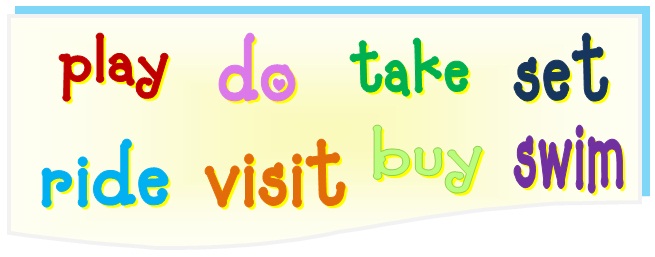
•Emma her English exam next week.
•It is very hot today. I in the lake.
•We our grandparents this weekend. We haven't seen them for a long time.
•John and his brother their bikes.
•I the table. It's time for lunch.
•David his homework after school.
•It's Paul's birthday next week. We him a present.
•His sister the violin at the concert.
(going to) "The future belongs to those who believe in the beauty of their dreams " Anna Eleanor Roosevelt
El futuro going to se forma:
SUJETO + am/are/is going to +VERBO EN INFINITIVO
El "future going to" se usa para:
Para formar la negación se añade not después del am/are/is:
Estructura:
Para formar la interrogación se invierte el orden del sujeto y del verbo auxiliar to be, esto es:
Un ejemplo claro es la oración:
se convierte en:
también puede contraerse tonight y is, quedando:
SUJETO + am/are/is going to +VERBO EN INFINITIVO
El "future going to" se usa para:
- Acciones que se ha planificado realizar en el futuro, usualmente en un futuro cercano.
- para acciones que van a suceder muy pronto o para expresar un plan que se tiene.
Para formar la negación se añade not después del am/are/is:
Estructura:
SUJETO + am/are/is not going to + VERBO EN INFINITIVO
Para formar la interrogación se invierte el orden del sujeto y del verbo auxiliar to be, esto es:
am/are/is + SUJETO + going to + VERBO EN INFINITIVO ?
Contracciones
En argot se contrae going to en gonna:Un ejemplo claro es la oración:
se convierte en:
también puede contraerse tonight y is, quedando:
viernes, 3 de octubre de 2014
Aviso
Buenas noches señores padres de familia se les comunica que el libro de inglés ya esta disponible para su compra en la escuela y lo comenzaremos a utilizar el día lunes. gracias por su interés y apoyo.
miércoles, 1 de octubre de 2014
Extra point 5
Grammar Exercises - Simple Past Tense.
Do the exercises below on the simple past tense
Suscribirse a:
Entradas (Atom)